How PieOS works
PieOS is an autonomous business operating system. It continuously understands, operates, monitors, optimises and grows your business by directing specialised AI workers, business intelligence and automations, while you stay in control of every high-risk decision.
The distinction that matters: PieOS is not a worker. It is what decides which work needs doing, dispatches the worker for it, and checks the result. A chief executive, not an employee.
Where to find it
Sidebar → HOME → PieOS.
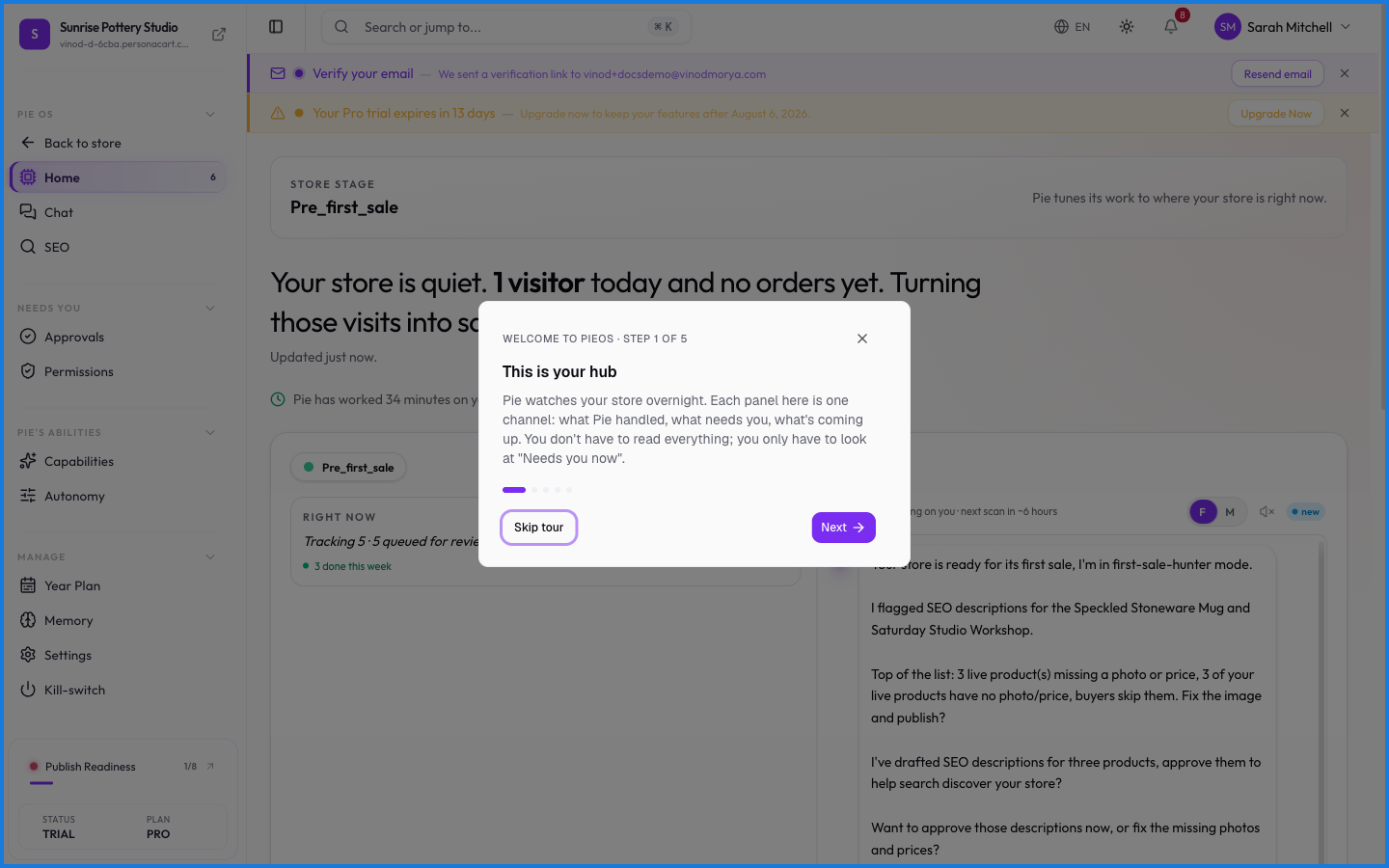
The business brain
Before PieOS can run anything, it holds a standing understanding of the business: the model, the niche, pricing, audience, revenue, goals, positioning, offers and funnels.
This is the difference between an assistant and an operating system. An assistant needs the context re-explained each time you ask. PieOS already knows what you sell, who buys it, what it costs you and where you're trying to get to, so a request like "we need more revenue this quarter" resolves into work rather than questions.
The workers
PieOS directs specialised workers, each responsible for one part of the business:
| Worker | Owns |
|---|---|
| SEO | Being found: keywords, structure, technical health |
| Marketing | Campaigns, sends, launches |
| Content | Pages, posts, product copy |
| Pricing | What things cost and when that should change |
| Support | Buyer questions and the queue behind them |
| Inventory | Stock levels, reordering, what's about to run out |
| Analytics | What the numbers are doing and why |
| Research | Competitors, market, what's changing outside your store |
| Finance | Revenue, payouts, what money is doing |
You don't manage the workers. You set direction and approve consequential decisions; PieOS assigns and sequences the rest.
What it watches, continuously
Business health is monitored rather than reported on request: revenue, traffic, uptime, payment failures, search performance, campaigns, conversion, AI usage.
The order matters. PieOS detects first, then acts where it's allowed to, then tells you — rather than surfacing a problem and waiting while it gets worse. Where the fix is consequential, it prepares the fix and holds it for your approval instead of sitting on the diagnosis.
How it decides
Signals become a chain of reasoning rather than an isolated alert:
Revenue is down → traffic is down → a keyword slipped → a competitor moved above you → propose a campaign → get your approval → run it.
That chain is why PieOS reads as an operating system and not a monitoring tool. A monitor tells you revenue fell. PieOS traces why and arrives with something to do about it.
Working to an objective
Tell PieOS what you want the business to achieve and the whole system reorders around it: priorities, queued work, which workers are busy, which campaigns run. A goal isn't a note in a document; it's what everything else is scheduled against. That's what the year plan holds.
Memory that is about the business
Memory isn't chat history. It's the business's own record: your preferences, decisions taken, experiments run, what failed, what worked, customers, pricing history, launches, campaigns, competitors.
It's also what makes PieOS improve rather than merely repeat — it can avoid a thing that didn't work last time because it knows it didn't work last time.
Where you stay in control
PieOS is autonomous, not unsupervised. Four controls decide what it may do:
- Permissions — the outer boundary of what it may touch at all.
- Approvals — anything consequential is proposed and waits for your yes. Low-risk work proceeds; high-risk work does not.
- Autonomy — how much it handles without asking, from "check with me on everything" upward.
- Kill-switch — stops everything instantly, whatever the autonomy setting.
This is deliberately how a good chief operating officer works: routine decisions are theirs, consequential ones come to you.
What happens — and what doesn't
- PieOS keeps running when you're offline. It doesn't need a conversation to work, and chat is one way in rather than the system itself.
- A "generate" or "propose" action is staged, not applied. It becomes real when you approve it.
- PieOS acts on your business only. Cross-store data is walled off at several layers and no instruction gets around it.
- It won't take a high-risk action to hit a goal you set. An objective changes priorities, never the approval gate.
What is PieOS?
An autonomous business operating system inside PersonaCart. It understands your business, runs and monitors the store, decides what work is needed, and directs specialised AI workers to do it — while consequential decisions wait for your approval.
Is PieOS a chatbot?
No. Chat is one way to reach it, not what it is. PieOS keeps operating and monitoring your business when nobody is talking to it, which a chatbot does not.
Does PieOS do the work itself?
No. It directs specialised workers — SEO, marketing, content, pricing, support, inventory, analytics, research, finance — deciding what needs doing and dispatching the right one. It runs the company rather than performing each job.
What happens when something goes wrong in my business?
PieOS detects it, traces the cause, and either fixes it where you have allowed that or prepares the fix and holds it for your approval. It reports after acting rather than only raising an alert.
Can PieOS see other creators' businesses?
No. It is scoped to your store, enforced at several layers, and no instruction can talk it into crossing that line.
Does PieOS change my store without asking?
Not for anything consequential. Those are proposed and wait in Approvals. You set how independently it works with the autonomy dial, and the kill-switch stops it entirely at any setting.
What this screen looks like in every state
| State | When you'll see it | What you see, and what to do |
|---|---|---|
| Loading | The screen is fetching your data | A skeleton in the shape of the finished page. It should be brief — if it persists, the load has failed rather than stalled. |